
A Top Entry Ball Valve is a type of ball valve designed with a removable bonnet or cover mounted on the top of the valve body. This design allows all internal components—such as the ball, seats, stem, and seals—to be accessed, inspected, or replaced without removing the valve from the pipeline.
Top entry ball valves are widely used in high-pressure, high-temperature, and critical service applications, particularly in the oil and gas, petrochemical, and pipeline transmission industries, where minimizing downtime and maintenance cost is essential.
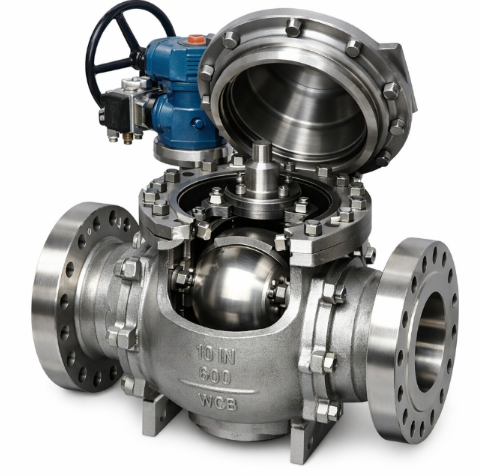
Top entry ball valves are typically manufactured with a one-piece or two-piece forged steel body, providing excellent mechanical strength and pressure resistance. The main components include:
Most top entry designs adopt a trunnion-mounted ball structure, where the ball is supported by upper and lower trunnions rather than floating freely. This reduces operating torque and improves sealing performance under high differential pressure.
When the actuator or manual operator turns the stem, the trunnion-mounted ball rotates 90 degrees to open or close the valve. The seats are spring-loaded or pressure-energized to maintain tight sealing. Because the valve bonnet can be removed from the top, internal inspection or seat replacement can be performed in-line, without cutting or dismantling the pipeline.
Understanding the difference between top entry and side entry ball valves is critical for proper valve selection.
Top Entry Ball Valves
Side Entry Ball Valves
Although top entry ball valves usually have a higher initial cost, their ability to reduce shutdown time and maintenance labor often results in lower total lifecycle cost, especially in large pipeline projects.
Top entry ball valves are primarily used in applications where reliability, safety, and serviceability are critical:
They are particularly suitable for fully welded pipelines, where valve removal would be extremely difficult or costly.
Internal components can be serviced without removing the valve from the line, significantly reducing downtime.
Maintenance can often be completed during scheduled shutdowns with minimal equipment and manpower.
Forged body construction ensures excellent resistance to pressure, temperature, and mechanical stress.
Top entry ball valves are commonly specified for emergency shutdown (ESD) and fire-safe applications.
Professional top entry ball valves are designed and manufactured according to internationally recognized standards, including:
Compliance with these standards ensures safety, reliability, and global project acceptance.
From a maintenance engineering perspective, top entry ball valves offer clear advantages:
These features make top entry ball valves a preferred choice for long-term, high-value pipeline assets.
When selecting a top entry ball valve, the following factors should be carefully evaluated:
Proper selection ensures optimal performance and service life.
Is a top entry ball valve better than a side entry ball valve?
Not always. Top entry ball valves are better for critical applications requiring in-line maintenance, while side entry valves are suitable for general service.
Why are top entry ball valves commonly used in pipelines?
Because they allow maintenance without removing the valve from welded or buried pipelines.
Are top entry ball valves more expensive?
The initial cost is higher, but the total lifecycle cost is often lower due to reduced maintenance and downtime.
Can top entry ball valves be fire-safe?
Yes. Many top entry ball valves are designed and tested according to API fire-safe standards.
A Top Entry Ball Valve is a critical valve solution for demanding industrial applications where safety, reliability, and maintainability are essential. Its unique top-access design, combined with robust construction and international standard compliance, makes it an ideal choice for oil and gas pipelines and other critical services.
For projects where downtime is costly and maintenance access is limited, top entry ball valves provide long-term operational and economic advantages.